

Supporting basic research in interface science, leading to the development of new industrial products
— Understanding phenomena and manufacturing from the viewpoint of interface science
| 2019/02/14 | Professor. Hideki Sakai & Professor. Kenichi Sakai: Department of Advanced Chemistry, Faculty of Science and Engineering, Tokyo University of Science |
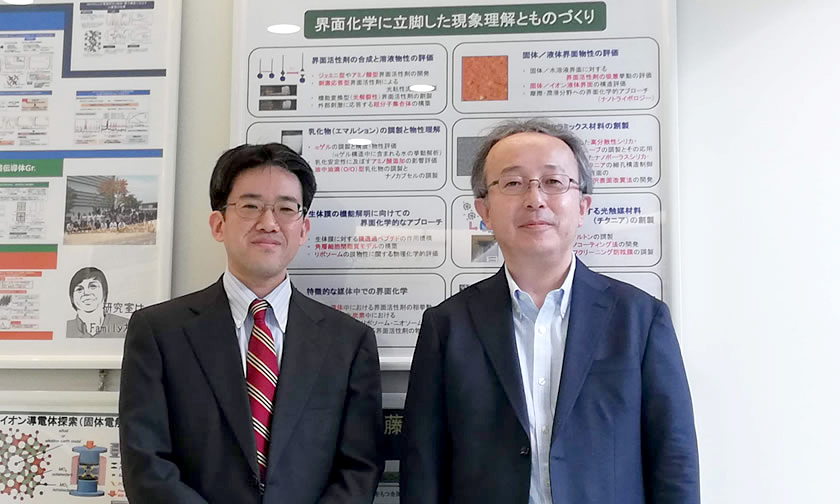
Prof. Kenichi Sakai (left) and Prof. Hideki Sakai (right)
Understanding phenomena and manufacturing from the viewpoint of interface science
――― Kyowa: Our partnership with your laboratory spans over two decades, originally established during the tenure of the previous professor. Could you give us an overview of the laboratory and its current initiatives?
Prof. Hideki Sakai: Our laboratory is located in the Department of Advanced Chemistry at Tokyo University of Science. We are conducting research on a wide range of topics, mainly in basic research and understanding of phenomena using interface science.For example, we are working on the research and development of a new surfactant, which we have called the "Gemini surfactant". Gemini-type surfactants tend to perform better than conventional ones; however, their production process can be quite complicated and costly for applications such as detergents or cosmetics. Also, since surfactants are considered harmful to the environment, we need to find ways to minimize their impact as much as possible. We are also researching and developing a Gemini-type surfactant that can be made using a relatively simple process, which is effective in small quantities and can be utilized in a variety of industrial products.
Prof. Kenichi Sakai: In this way, it is the purpose of our laboratory to clarify the interfacial phenomena that we have not understood until now. Then, to develop new materials that have a practical application in real-world settings based on our findings.
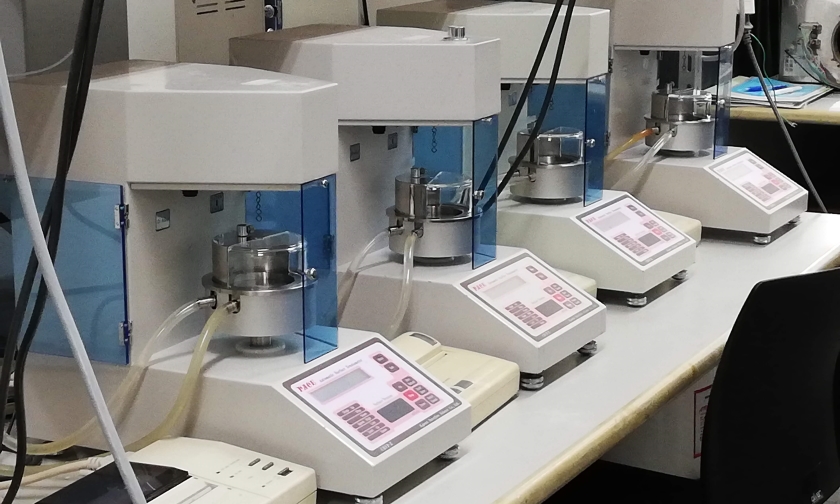 ▲Kyowa's surface tensiometers
Meticulous after-sales follow-up to deepen trust
――― Kyowa: You utilize many of our products, including our instruments for surfactant analysis. Compared to those of other manufacturers, what specific advantages or benefits do you feel our products offer?
Prof. Hideki Sakai: We’ve got some instruments from overseas manufacturers, too, but I find the ones from Kyowa Interface Science much easier to use. I also appreciate your quick support whenever there’s a maintenance issue, and the valuable advice you provide us regarding measurements.Prof. Kenichi Sakai: Since many overseas manufacturers are based in Europe and North America and have local agents in Japan, repairs can occasionally take some time, as the instruments may need to be sent overseas. In some cases, sales agents may not be deeply familiar with the technical aspects of the instruments. In this respect, we really appreciate the technical support team at Kyowa Interface Science, who have a deep understanding of even the finer details of the technology.
Prof. Hideki Sakai: As our research progresses, students often come up with new requests, such as “Can we try this kind of measurement?” There was a time when we wanted to measure surface tension under low-temperature conditions. When we tried to do it ourselves, frost formed on the equipment and we couldn’t obtain accurate measurements. When we consulted the technical sales staff at Kyowa Interface Science, they provided us with precise advice on how to achieve accurate results. Thanks to their support, we were able to solve the issue quickly without having to purchase any new instruments. They’re truly a reliable company that we can count on.
――― Kyowa: We are deeply honored by your trust. By the way, when it comes to purchasing new instruments, what key criteria or factors do you look for when selecting the equipment and the manufacturer?
Prof. Kenichi Sakai: When choosing, we focus on two types of trust: “trust in the instruments” and “trust in the company.” I think trust in the instruments comes from long-term use in the laboratory, showing that they can provide reliable data consistently without major problems. We also consider what instruments are being used by other research institutions and laboratories. As for trust in the company, integrity is key. That includes commitment to maintenance after purchase, as well as flexible and responsive support for the lab. When selecting products, we evaluate both of these aspects over the long term.
Prof. Hideki Sakai: Also, when we compare the specifications of similar products from different manufacturers, we can provide a sample to them for testing and see the results. We find Kyowa Interface Science particularly reliable, because they are open to our suggestions for improvement and willing to make adjustments based on the testing process.
The importance of manual instruments in the academic research
――― Kyowa: Could you tell us about the usability of the instruments?
Prof. Hideki Sakai: From the perspective of a university laboratory, or from the viewpoint of educators, we believe it’s important to have both a convenient, user-friendly automated instrument as well as a manual one. From the perspective of students who actually use the instruments, automated devices are very convenient, since measurements can often be completed with the push of a single button. For longer experiments, such as those taking an hour, students can focus on other tasks while waiting for the results. However, relying solely on automated devices carries the risk of missing important events that occur during measurements. For example, when unexpected results appear, some students have asked, “Could there be a mistake in the data?” Some students don’t seem to consider the possibility that there might be an issue with the instrument itself. They tend to assume that the device is always correct since it handles the measurements automatically, even though it would be more appropriate to question whether any problems occurred during the experiment. From this perspective, we also make use of instruments that require manual operation. Although they can be somewhat more time-consuming, these devices allow students to monitor each step of the measurement and respond to any unexpected situations.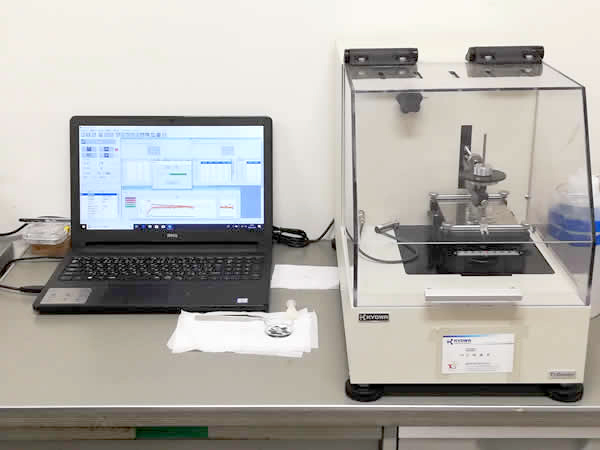
▲Friction tester TSf-503
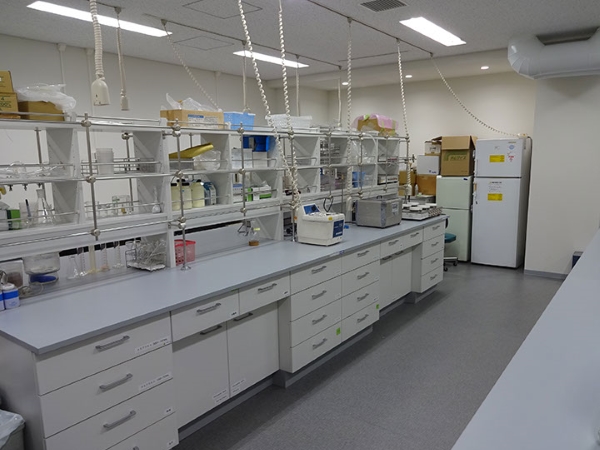
▲Inside the laboratory
Prof. Kenichi Sakai: I believe it is essential for students’ education that they gain hands-on experience with a variety of instruments. By using them regularly, students become familiar with how each device operates. After graduation, students often carry the skills they’ve gained into their careers, applying their experience with these instruments at companies or research institutes. In some cases, they even suggest introducing the devices they used at university into their new workplaces. We are pleased when the instruments we use at the university can be applied in new settings. As mentioned earlier, we generally prioritize devices that provide reliable results when making new purchases; however, we also occasionally invest in entirely new types of instruments. Because the instrument is entirely new, there are no prior results to reference. However, if it is cited in publications and the device becomes more widely used, we can contribute to the advancement of interface science. That, as a researcher, is very rewarding.
Aiming to be a laboratory that contribute to the industry
――― Kyowa: Could you tell us about your future research plans and collaboration with our company?
Prof. Hideki Sakai: As our research progresses, we anticipate the need to perform measurements under specialized conditions while also monitoring other physical properties. I’m confident that new requirements will continue to emerge as our work evolves. Our laboratory also utilizes Kyowa Interface Science’s LB film deposition equipment; however, our research often requires simultaneous measurements during film formation. For this reason, I hope to collaborate closely with Kyowa Interface Science and, where possible, explore the development of new instruments together.
――― Kyowa: At Kyowa, we approach our work with a profound sense of mission, driven by the belief that ‘if we don't develop this instrument, who will?’ We are fully committed to creating unique, specialized equipment that other manufacturers simply cannot. Thank you both so much for sharing your time and insights with us today.