

Exploring the Mysteries of Interface Science for Human Happiness
— A Lifelong Passion for Emulsification - the Art of Mixing Oil and Water
| 2020/02/25 | Toshio Sakai, Professor — Department of Materials Chemistry, Faculty of Engineering, Shinshu University |
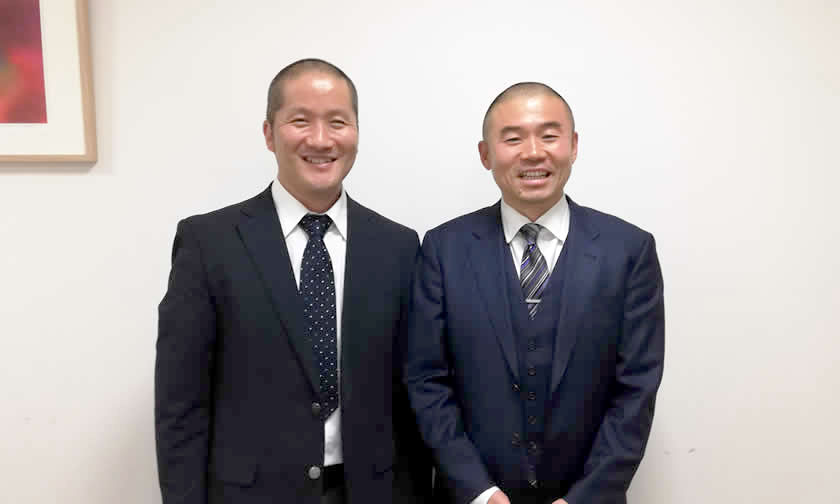
Professor Toshio Sakai (left) and Kyowa Interface Science, Mr. Kamei (right)
In collaboration with Kyowa, we support his research by providing high-precision surface tensiometers and working together on the development of new instruments.
A Lifelong Passion for Emulsification - the Art of Mixing Oil and Water
――― Kyowa/Kamei: Dr. Sakai, could you give us an overview of your research field?
Prof. Sakai: As you all know, oil and water don’t mix under normal conditions. By adding emulsifiers, you can weaken the interfacial tension between them and create a more stable mixture that resists separation.
My research, however, focuses on emulsions made without any emulsifiers—systems where colloidal droplets remain dispersed using only oil and water. Emulsions and other colloidal dispersion systems are considered metastable, so in order to understand how they stay dispersed, we first need to understand what “metastable” really means.
――― Kyowa/Kamei: So you’ve been pursuing this line of research ever since your university days?
Prof. Sakai: Back when I was a student, I didn’t have a clear idea of what career I wanted to pursue. I ended up joining a lab in interface science simply because a senior student invited me.
The theme I was given there was “the science of metastability.” As you know, emulsions of oil and water can be stabilized with emulsifiers. I became fascinated by the question: how can we create a metastable state in the first place? That curiosity is what drew me into this field. As my research progressed, I gradually started thinking, “I want to keep doing this at a university.” Honestly, if I hadn’t encountered this theme, my life would’ve turned out very differently.
To tell the truth, though, at the time I didn’t think that dream would ever come true. I had pretty much given up on becoming a university researcher. After completing my master’s degree, I didn’t pursue a PhD—I became a high school teacher instead. But the desire to do research at a university never really went away. Eventually, I quit teaching and enrolled in a doctoral program, picking up my work on metastability and emulsification again. After earning my PhD, I moved around quite a bit—doing postdoctoral work at places like the State University of New York—which meant I drifted away from my original research for a while.
And as time went on, the possibility of getting a faculty position felt more and more distant. So, while I was in the U.S., I started applying for jobs and ended up receiving an offer from a company there. I was all set to start a career in industry. But in the end, I just couldn’t let go of the dream of doing research at a university in Japan. I turned down the offer and came back home. After spending two years at my alma mater, Tokyo University of Science, I was fortunate enough to be offered a position here at Shinshu University, where I work today. It was a long and winding road, but that dream finally came true—and now I spend my days immersed in the invisible world of interfaces.
My Encounter with Kyowa Interface Science
――― Kyowa/Kamei: What led you to consider our surface tensiometers?
Prof. Sakai: The world of interfaces is invisible. To study it, we have no choice but to measure interfacial tension and other physical properties—things we can see—and then build our understanding from there.
For the systems I study, like water and oil, there are plenty of measurements reported in the literature. Until then, I had basically conducted all my research and experiments based on the numerical data published in papers, so I hadn’t had the opportunity to perform the measurements myself.
But there’s a catch: the values reported in the literature often come from measurements of completely separated water and oil. Simply put, if you mix water and oil so that tiny droplets of oil are suspended in water, the measured values might actually be different. I was looking for equipment that would allow us to measure those values accurately ourselves—and that’s when I came across Kyowa Interface Science.
――― Kyowa/Kamei: That’s why you decided to visit our showroom.
Prof. Sakai: I brought some of my students from the lab to Kyowa Interface Science’s showroom. It wasn’t just a tour—we really wanted to get hands-on with the equipment.
At first, when we explained our research to the staff member in charge, the reaction wasn’t exactly what we had hoped for. In other words, it didn’t seem like the work immediately grabbed their interest. Initially, they probably couldn’t quite see what was so special about it.
But then they actually tried the experiments themselves using the equipment—and asked, “Wait, why don’t the oil droplets merge?”—which caught me a bit by surprise!
From that moment, Kyowa became genuinely interested in our research. That’s how we built a collaborative relationship, where Kyowa not only provides the instruments we need but also cooperates with us in developing new equipment tailored to our research.
Bringing Happiness to People through Interface Science
――― Kyowa/Kamei: What do you find most fascinating about interface science?
Prof. Sakai: The field I study—colloid interface science—has a history of about 150 years, yet it remains full of mysteries. I think the real fascination of interface science lies in unraveling these mysteries.
Surfactants have been used as detergents for a very long time. In fact, the act of cleaning with detergents dates back to the ancient Mesopotamian civilization. Why were people using detergents so long ago?
I like to think that even in those times, people understood that cleaning brings happiness to everyone.
I believe surfactants are one of humanity’s greatest inventions. Without them, modern life as we know it would be impossible. Take shampoo for washing hair, or soap for washing the body—these everyday products all contain surfactants. Using them leaves us feeling refreshed and comfortable, and in that sense, contributes to people’s happiness.
Opportunities for the general public to learn about interface science are rare, but it’s interface science that makes our modern lifestyle possible. As researchers, we work every day to control interfaces and provide even a little happiness to people. To maximize that happiness, we need to deepen our understanding of the world of interfaces. That’s why we established the Colloid & Interface Science Research Center at the Faculty of Engineering, Shinshu University. I hope this research center can contribute to that goal.
――― Kyowa/Kamei: I believe the mission entrusted to us is to uncover all the remaining mysteries in the field of interface science. At Kyowa, we are fully committed to supporting this mission and helping to unravel these mysteries.
Prof. Sakai: We are very grateful for all the support we’ve received. When we ask, “Could you do this?” and they respond to our seemingly impossible requests, I think it’s because we share a common understanding: that we want to accomplish this mission together.
Kyowa has a remarkable ability to understand our needs through casual conversations and respond sincerely. I also find it reassuring that they are willing to work with us on developing new equipment. Moving forward, let’s continue to uncover as many mysteries of interface science as possible, while sharing the wonder of this field with more people, more widely.
――― Kyowa/Kamei: It’s our pleasure. Thank you very much for sharing so much with us today.