

The Role of Contact Angle Meters in Ensuring Customer-Focused Product Development
— Contributing to High-Quality Adhesive Products with Reliable Measurement Technology —
| 2020/09/28 | Mr. Sho Watanabe: Technical Department, Kuramoto Sangyo Co. |
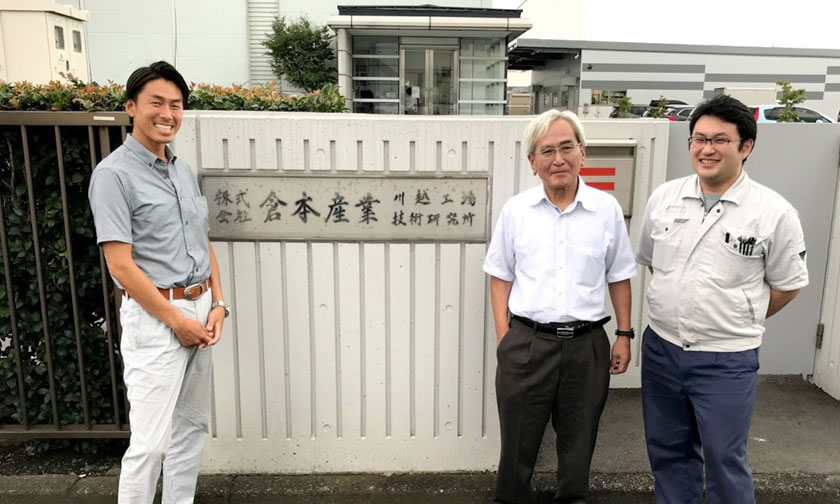
Kyowa Interface Science: Mr. Kamei (left), Mr. Hoshino (center) / Kuramoto Sangyo: Mr. Sho Watanabe (right)
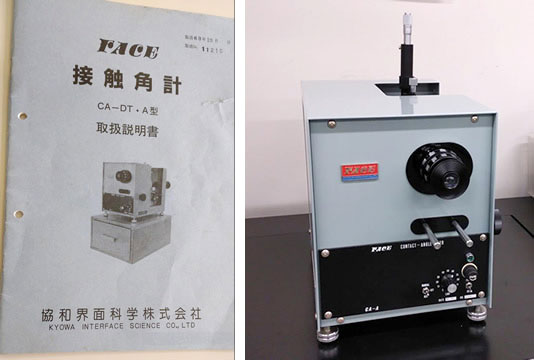
The company manufactures a wide range of products — including high-quality adhesive sheets and labels, heat-resistant protective clothing, and various safety-related facilities and equipment — where exceptional reliability is required. Among these, our contact angle meter is used in the development, improvement, and evaluation of their adhesive products. The instrument was originally delivered in 1988, and remarkably, it is still in active use more than 30 years later. We spoke with Mr. Sho Watanabe from the Technical Department to learn about the specific applications and evaluation methods.
Delivering High-Quality Labels and Adhesive Stickers
――― Kyowa/Kamei: Could you please introduce your company and its main business activities?
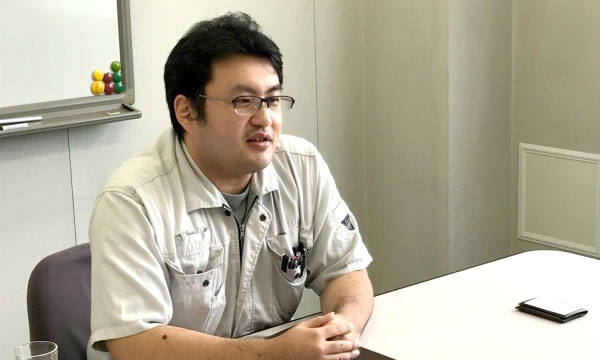
Mr. Watanabe: Our company specializes in adhesive products such as labels and stickers, managing everything from the development of adhesives to their application on substrates, as well as printing and shaping, all within an integrated production system.
Although we produce labels and stickers, most of our products are not for general retail. Our main clients are manufacturers of motorcycles, automobiles, and ships. We focus on printable adhesive products that maintain a beautiful appearance and excellent weather resistance, even under harsh conditions. Since many of our clients prioritize performance, our core business is developing and producing custom, one-of-a-kind products tailored to each customer’s specific requirements.
――― Kyowa/Kamei: Mr. Watanabe, you are involved in the product development department and have worked on creating adhesive products that did not exist before, correct?
Mr. Watanabe: Yes. I am currently focused on printer labels and the development of adhesive products used in electronic components. My main responsibilities include developing new adhesive products that cannot be met with standard, off-the-shelf options, as well as improving existing products. As a result, I often work on entirely new products that didn’t exist before. Our company was the first in Japan to develop adhesive labels using aluminum-deposited polyester film. In addition, we were the first in the world to develop water-soluble adhesive labels. Building on that pioneering spirit, we continue to develop and improve high-quality products day and night.
Contributing to New Product Development with a Versatile Contact Angle Meter
――― Kyowa/Kamei: How are you utilizing the contact angle meter that our company supplied?
Mr. Watanabe: We mainly use the contact angle meter to measure the adhesive strength between substrates, such as films, and the adhesive itself. For example, when a label is peeled off, the adhesive or the substrate may remain on the surface. This happens because the adhesive strength between the substrate and the adhesive is insufficient.
To strengthen the adhesion, we apply various treatments to the substrate. We use the contact angle meter during the design stage to verify the effectiveness of these treatments and to identify potential causes of defects.
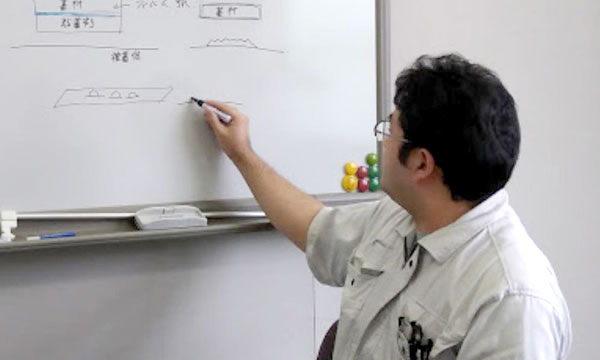
――― Kyowa/Hoshino: In other words, you are using the contact angle meter to evaluate the compatibility between the treated substrate and the adhesive, correct?
Mr. Watanabe: That is right. Specifically, we drop a liquid onto the treated substrate and observe its wettability. If the liquid spreads across the substrate's surface, the contact angle is small, indicating the adhesive can penetrate easily and bond strongly to the substrate. Conversely, if the liquid does not spread, the contact angle is large, indicating insufficient adhesion. Poor adhesion can cause the adhesive to remain on the target surface, preventing the desired adhesive strength from being achieved.
――― Kyowa/Hoshino: Since films are generally water-repellent materials with large contact angles, they require treatment to enhance adhesion. So, you are using the contact angle meter to measure the effectiveness of those treatments, correct?
Mr. Watanabe: Exactly. For our clients in the electronic components sector, for example, if even a tiny bit of adhesive remains when a label is peeled off a silicon wafer, the product becomes unusable. When developing new adhesive products or evaluating existing ones, we repeatedly measure contact angles with a contact angle meter to ensure labels can be removed cleanly, leaving no residue. This is how we prevent any disadvantage to our customers.
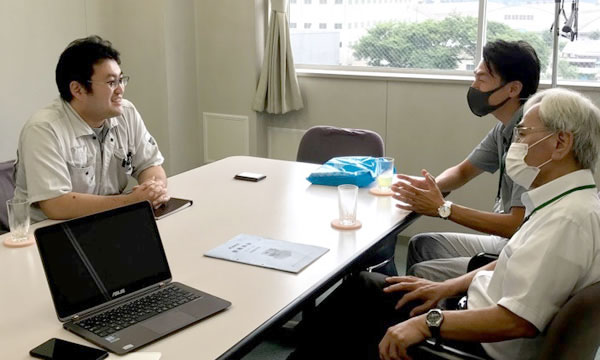
――― Kyowa/Hoshino: With a contact angle meter, it seems you might not even need instruments like an SEM (scanning electron microscope), right?
Mr. Watanabe: Preparing samples for an SEM is quite labor-intensive, and the equipment itself is very expensive. The contact angle meter, on the other hand, allows for easy measurements and is much more affordable, making it much more user-friendly.
――― Kyowa/Hoshino: Is one advantage of using the contact angle meter that it allows non-destructive testing? With instruments like an SEM, you sometimes have to damage the material to take measurements, don't you?
Mr. Watanabe: That is another advantage. For example, when a customer brings in a product saying, "We want to attach this," we cannot damage it. Especially in cases where the product is a one-of-a-kind prototype or needs to be returned, an SEM simply cannot be used. In such situations, the contact angle meter is very effective. In practice, for automobiles or motorcycles, the substrates are often quite large. Normally, these would need to be processed to fit into an SEM, but the contact angle meter offers greater flexibility in sample size. Additionally, if you are using a handheld model, you can measure samples regardless of size, which is another major benefit.
Proven Reliability and Trust: The Appeal of Kyowa Interface Science
――― Kyowa/Kamei: You are still carefully using the contact angle meter that we supplied over 30 years ago, aren't you?
Mr. Watanabe: The contact angle meter we received in 1988 is still in active use today. I believe the ability to provide a measuring instrument that remains reliable for such a long time is one reason why Kyowa Interface Science is so trusted. Beyond this device, if you look up measuring instruments used in our work online, you’ll see that Kyowa products are overwhelmingly common.
――― Kyowa/Kamei: For example, when considering the purchase of a new measuring instrument, what criteria does your company use to make the selection?
Mr. Watanabe: First, we prefer domestic manufacturers. One reason is the user-friendly interface. Measuring instruments from overseas manufacturers aren’t designed specifically for Japan, so there are inevitably some usability challenges. Another reason is the reliability of maintenance support. With domestic manufacturers, we have peace of mind knowing that if repairs are needed, they can respond quickly.
Among domestic manufacturers, Kyowa Interface Science is naturally one of the top candidates, given its overwhelming market share in our industry. Their quality is excellent, and their responsiveness is remarkable. We have consulted with them on various matters, so when it comes time to replace equipment, Kyowa would be our choice. Their track record of instruments lasting for decades speaks volumes.
Personally, I strongly hope to upgrade to a new contact angle meter that can measure quickly and accurately, since the support period for our existing equipment has already ended. However, the sad reality is that the current instrument is still running well, making it difficult to obtain approval for the upgrade.
――― Kyowa/Hoshino: Your company also participated in the industry-academia joint research of the Adhesive Research Association, which we are involved in, didn't you?
Mr. Watanabe: That's right. At that time, we had the opportunity to try out the latest measuring instruments. Naturally, the new equipment is much easier to use. It can automatically capture time-dependent changes in photos and videos, making it very useful for wettability tests. Another advantage is that everything is automated, so there is no variation caused by different operators. From a quality assurance perspective, this is extremely important. The latest models use software developed in-house by Kyowa Interface Science, which adds another layer of reassurance.
Uncovering Hidden Needs in Innovative Manufacturing
――― Kyowa/Kamei: We hope to continue supporting you in various ways. Are there any specific requests or products you would like us to provide?
Mr. Watanabe: It would be helpful if you could provide web content showcasing practical examples. I have attended several of Kyowa Interface Science's seminars, and they often present cases such as, "When this measurement was performed, this kind of result was obtained." Given the current circumstances, there are fewer seminars, so I would greatly appreciate it if you could continue sharing information on your website or through webinars.
――― Kyowa/Kamei: Could you share your future aspirations and how you see your ongoing relationship with our company?
Mr. Watanabe: Actively engaging with new technologies leads to the development of new products. It is also our mission to showcase our technologies at exhibitions to discover hidden needs and acquire new customers. In that context, measuring instruments that allow for objective evaluation are extremely important. Even minor errors can affect our company’s credibility. In this regard, Kyowa Interface Science has earned tremendous trust as a provider of highly accurate instruments. We hope to continue collaborating with you in the future.
――― Kyowa/Kamei: We look forward to continuing our collaboration. Thank you very much for sharing your insights with us today.
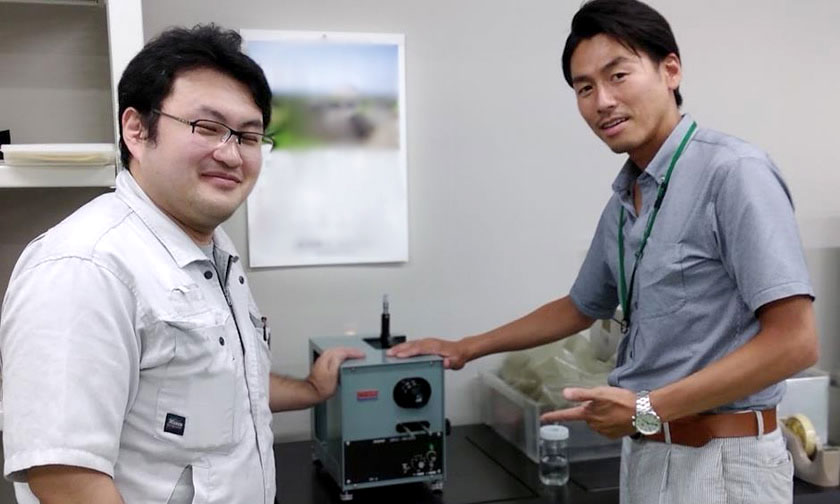
▲Mr. Watanabe (left) and Executive Director Kamei (right) with their hands on the CA-A model contact angle meter