

Adopting industry-standard measuring equipment to ensure reliable data
| 2019/06/03 | Fuji-WPC Co., Ltd |
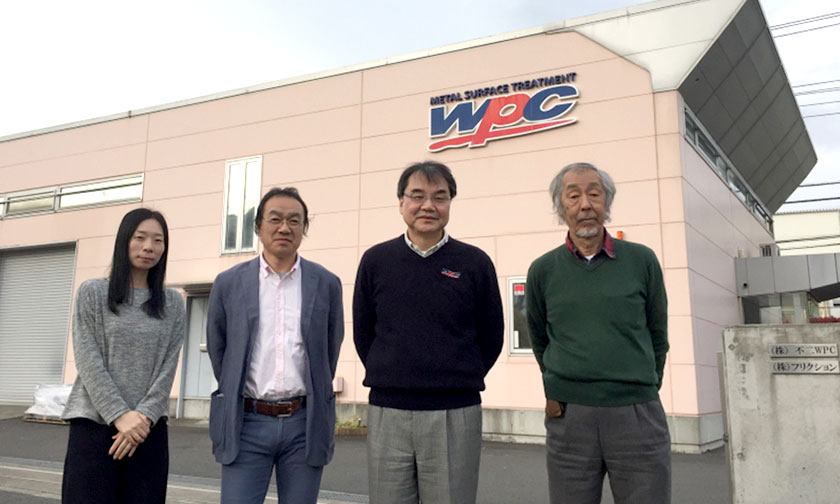
From left: Ms. Tomoko Nishitani (Researcher, Technical Department), Mr. Hidemi Ogihara (Manager, Development Department), Mr. Eiji Shimohira (President and Representative Director), Dr. Masao Kumagai (Doctor of Engineering / Director, Manager of Technical Department)
Surface modification technologies that solve diverse customer challenges
――― Kyowa: Could you tell us about your company's business activities?
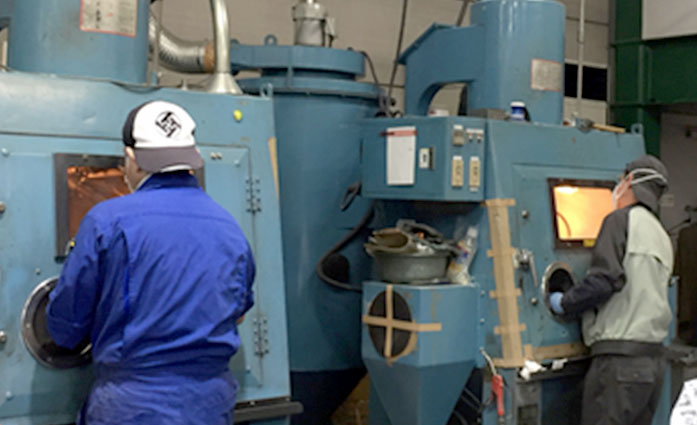
Mr. Shimohira: We conduct research and provide processing technologies for surface modification.One of our key technologies is WPC® treatment—a metal surface treatment that improves fatigue strength and enhances sliding properties. It’s used in a wide range of industries, especially in the automotive and motorsports fields, but also in general industrial machinery, mechanical parts, and even mold manufacturing.
In recent years, our surface modification technologies have also started to be used in the food industry. They help reduce the risk of foreign material contamination and help cut down on food waste. To give you a simple example: when you make patties, the meat and fat stick to the inside of the bowl, right? By applying a surface modification treatment that prevents sticking, we can reduce that residue. It also makes the bowl much easier to clean, which leads to cost reductions in food factories.
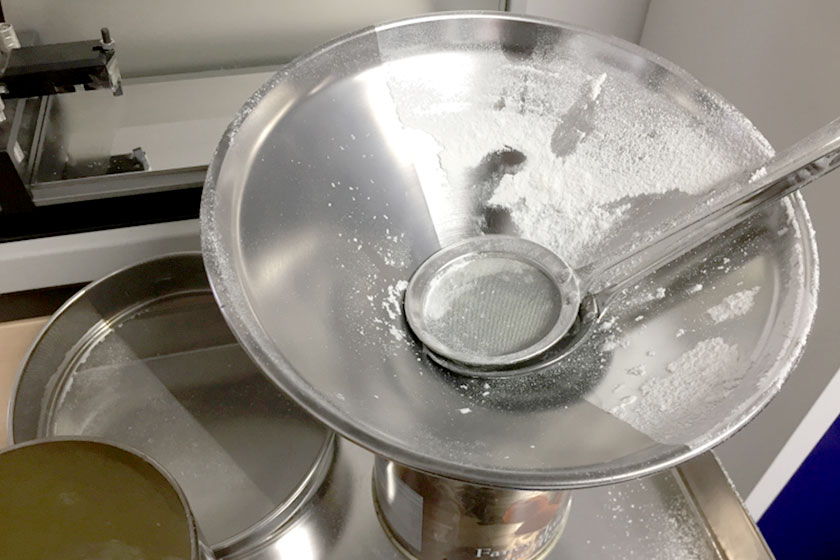
To develop these kinds of technologies—like improving slipperiness or preventing ingredients from sticking—we run various R&D projects. For an accurate, quantitative evaluation, we use Kyowa Interface Science’s instruments for measuring surface free energy.
Data you can trust—thanks to equipment widely recognized across the industry
――― Kyowa: You have used Kyowa's portable contact angle meters, but why did you choose our products again?
Mr. Kumagai: The first time I came across Kyowa Interface Science’s contact angle meters was when I saw them being used at the Kanagawa Prefectural Industrial Technology Research Institute. The model they had was operated manually, but when I contacted Kyowa directly, they introduced us to their portable contact angle meter that performs the measurements we needed fully automatically. Because the measurement is automated, there are no operator-to-operator differences, and we can obtain much more reliable data. The instrument is also straightforward to use, which was another major reason we decided to adopt it.Mr. Shimohira: From a customer’s perspective, the fact that we can say “This was measured with Kyowa’s equipment” is a big advantage. It immediately gives credibility to the data.
Mr. Kumagai: If we used equipment from an unknown manufacturer, customers might wonder, “Is this data really trustworthy?” But Kyowa Interface Science is well known in this industry. Customers can easily picture the kind of equipment we use, and they already understand its reliability.
Ms. Nishitani: I think anyone involved in surface analysis—researchers, developers, universities, research institutes—would be familiar with Kyowa Interface Science. The instruments are widely used, and they’re also reasonably priced, which is another benefit.
Mr. Kumagai: Evaluation and analysis instruments from other companies can cost tens of millions of yen—or even hundreds of millions, depending on the model. Being able to get equipment that performs the same measurements at a much more reasonable price is extremely appealing. At this price point, the instruments are likely to become widely used across the industry. And as Kyowa’s market share grows, the reliability of the analysis data we present also increases. That, in turn, makes our own sales activities much smoother. So, we genuinely hope Kyowa continues to expand its presence.
Competitive advantages that even large companies can’t match
――― Kyowa: You mentioned you also use instruments from other manufacturers. What is the difference between their roles?
Mr. Kumagai: Rather than dividing them strictly by role, we focus on using them in a way that lets us provide data our customers can truly trust. For analysis and evaluation, I believe the number of instruments you use is absolutely crucial. Data measured with just one instrument isn’t enough—Its validity should be verified by comparing results from different types of equipment. Surface free energy measurement, in particular, is challenging. Data from a single manufacturer’s instrument isn’t 100% reliable or universally accepted. From that perspective, we often measure the same sample first with equipment from other manufacturers, and then again with Kyowa’s instruments. By cross-checking results, we can verify the surface's physical properties with greater confidence.Of course, simply owning many instruments doesn’t mean much if all you do is collect the data. Our strength lies in analyzing data from different sources and gaining unique insights. Even as an SME, companies like us can afford to introduce various types of equipment and build specialized technical expertise. This helps us differentiate ourselves in the industry.
Mr. Shimohira: I think it’s amazing that an SME like us can operate at this level. A company with only a few dozen employees can sometimes have world-leading technology and even capture 90% of the global market in a niche field. Large companies are often strong, but there are areas where SMEs can compete—and even outperform them. Using Kyowa’s instruments as part of our technical presentations really helps highlight that unique strength.
――― Kyowa: Taking on new challenges and deepening your technological capabilities is also one of your company's strengths, right?
Mr. Shimohira: Trying something new is like opening a new door. Even if there’s a wall in front of you, if you push through it, you get to see a completely different world. That’s what I consider a true challenge. For example, we once received a request to develop a surface treatment that would prevent meat and fat from sticking to bowls during hamburger preparation. At first, even we weren’t sure it was possible—but we managed to accomplish it successfully.Mr. Ogihara: In fact, a surface treatment that prevents adhesion 100% is physically impossible at this stage. But as an engineer, I still want to explore the technology as deeply as possible and strive for perfection. Even if a customer is satisfied, I always ask myself, “Can we do even more?” That mindset drives how I work.
Ms. Nishitani: Sometimes when I’m working on other projects, I realize, “Ah, we could apply the technology we used for hamburgers here.” Moments like that help us deepen our technical expertise even further. We get a lot of technical inquiries every day, but if we approach them thinking, “We can’t do this because the next project is coming up,” that’s the end of it. Instead, we look for clues in each project that could lead to new ideas or techniques. This not only allows us to deepen our research but also helps us develop the agility to handle many projects quickly and effectively.
Aiming to be a surface treatment solutions company
――― Kyowa: Could you tell us about your future aspirations and your relationship with Kyowa Interface Science?
Mr. Shimohira: Being close to our customers is one of our greatest strengths. Requests from the field reach our researchers quickly and accurately, which allows us to address a wide range of customer challenges. In the future, we aim to become a true solution company—a partner that helps our customers solve their problems.Mr. Kumagai: For example, when a customer’s equipment breaks down, we examine the fracture surface to identify the cause and suggest the appropriate surface treatment. Since the best approach varies depending on the type of breakage, we can provide solutions tailored to each situation.
Mr. Shimohira: Currently, we are researching surface treatments to prevent wet vegetables from sticking to equipment in food factories. You may have experienced this at home—vegetables sticking to a colander or bowl, making them hard to remove. By quickly removing the water with a shooter, for example, we aim to make surfaces more slippery. It would be great to have devices that can measure water behavior in this process to optimize these treatments.
Mr. Kumagai: In such a specialized industry, the equipment we need isn’t always available on the market. Recently, we visited the Kyowa Interface Science showroom to see devices capable of dynamic measurements. Kyowa is excellent not only in manufacturing but also in research and development, and we greatly value their responsiveness. We hope to collaborate with Kyowa to develop new devices together.
――― Kyowa: We would be very happy to cooperate. Thank you very much for sharing your time and insights with us today.
Fuji-WPC's website (Japanese website)