

Facing the Unpredictable Behavior of Liquids Amid Environmental Changes
— Inside the R&D Lab of a Long-Established Manufacturing Company —
| 2026/03/06 | Mr. Soshi Hokonohara: Research & Development Department, Seiko Co., Ltd. |
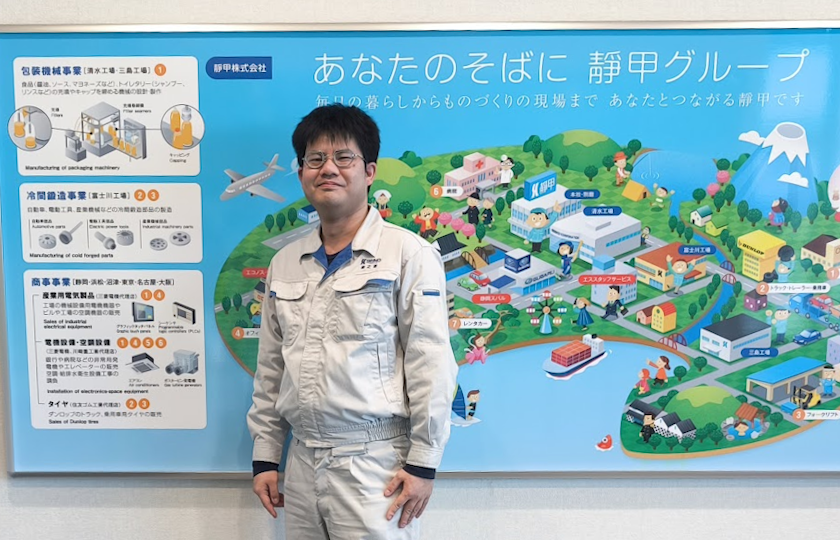
Mr. Soshi Hokonohara, Research & Development Department, Seiko Co., Ltd. and Kyowa Interface Science Interviewer
Customer Information
Seiko Co., Ltd. (https://www.seiko-co.com/)
Business Activities:
・Manufacturing, sales, repair, and modification of packaging machines and general industrial machinery
・Production and sales of cold-forged products
・Sales of FA equipment, air-conditioning and refrigeration equipment, and electrical devices, as well as installation of air-conditioning systems
Since its founding in 1939, Seiko Co., Ltd., based in Shizuoka City, Shizuoka Prefecture, has been supporting Japanese manufacturing for over 80 years. In the production of filling machines—essential equipment for food and pharmaceutical production lines—the company has long been committed to working carefully with the diverse range of liquids unique to each customer.
A key challenge lies in ensuring that clients using these filling machines do not encounter issues such as dripping or spills on the production floor. To prevent such problems, Seiko’s engineers have historically relied on experience and on-site adjustments during the design and pre-delivery setup stages to understand and optimize the properties of each liquid. The company’s Research & Development Department is now taking this process a step further. By applying numerical data and scientific methods, they aim to tackle these challenges from a perspective separate from the production floor. In this article, we spoke with Mr. Soshi Hokonohara at the Shimizu Factory to learn more about the department’s initiatives.
“As Usual” Doesn’t Apply: The Challenge of Accounting for Environmental Changes in
Liquid Properties
——— What prompted the R&D Department to start building a database of liquids in the first place?
Mr. Hokonohara: One of the most critical issues we need to avoid with the filling machines we manufacture is dripping. If the liquid doesn’t stop cleanly at the nozzle in a customer’s factory, it can directly lead to line contamination and defective products.
What makes this particularly tricky is that even the same liquid can behave differently depending on environmental conditions. A classic example is temperature. In a cold factory in winter, say around 10℃, versus a hot factory in summer, around 30℃, the properties of the liquid—like viscosity and surface tension—can change. The machine settings and liquid recipes haven’t changed, yet sometimes you get problems like, ‘Why is it suddenly not stopping properly now that it’s winter?’ This is exactly the kind of trouble we’re trying to prevent.
Reference: What is a filling machine?
https://www.seiko-co.com/hoso/filling/
——— It must be extremely difficult to anticipate all the changing conditions during the design stage, isn’t it?
Mr. Hokonohara: Exactly. Until now, experienced engineers would handle these changes based on intuition—thinking something like, ‘If we switch to this nozzle, it should solve the problem’—or they would make adjustments on-site. The problem with that approach is that it relies heavily on individual expertise. To anticipate how a liquid’s properties will change due to environmental conditions and to create metrics that anyone can use to make objective decisions, we realized we needed a database built on numerical data rather than just intuition. This is how our "Liquid Database Project" got started.
Matching with Past Data: The First Step Toward Quantifying Designs
——— When getting the project off the ground, what specific activities did you start with?
Mr. Hokonohara: First, we started by setting up a proper measurement environment to accurately capture how liquids behave under changing conditions. Regarding the measuring instruments, we already had over 10 years of operational experience, including from our time at the Mishima Factory, and had been using them for a long time here at the Shimizu Factory as well. So, we already had a high level of trust in products from Kyowa Interface Science.
For full-scale implementation, it was also necessary to carefully consider the features required to ensure anyone could obtain accurate, reproducible data. I remember hearing that some models allowed measurements under temperature control and automatic data collection, and that it was possible to actually operate and compare several models. We even brought samples to their showroom in Niiza, Saitama, to run tests. During that visit, we were able to see the characteristics of each model in action and discuss our own operational needs on the spot. This hands-on consultation helped us select the model that best suited our purposes.
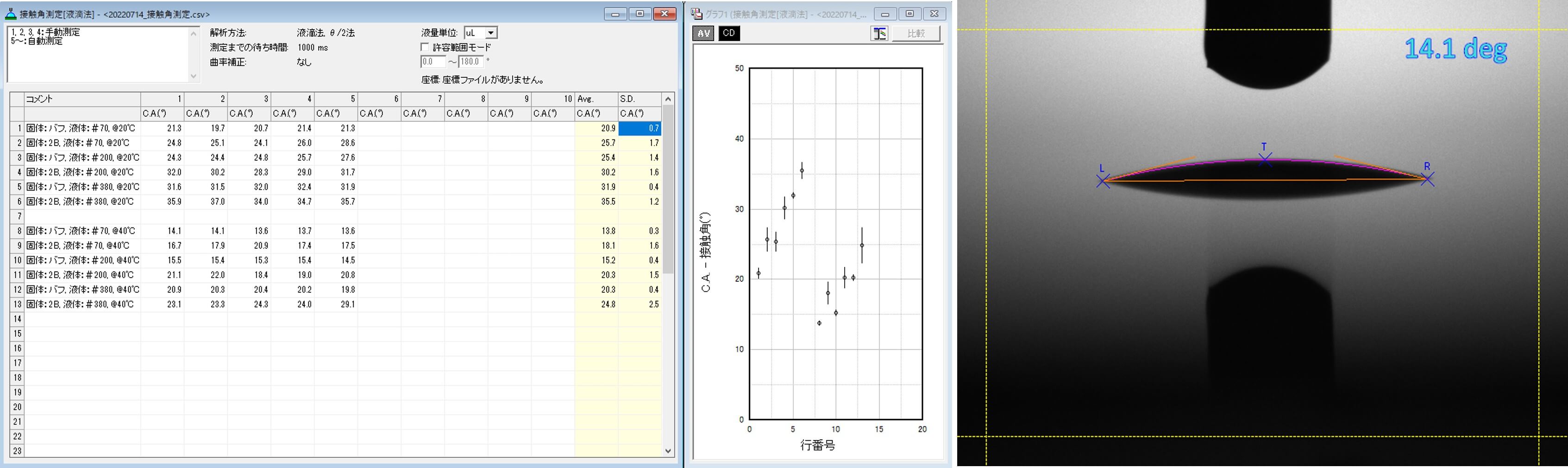
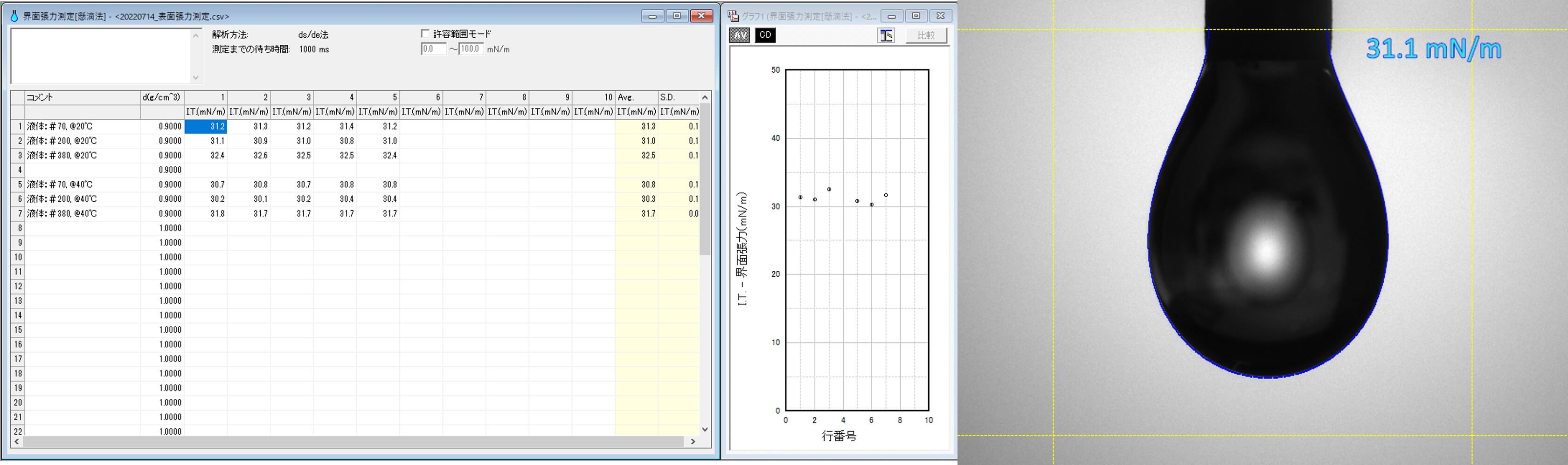
In terms of actual operation, when we receive a new project, we first measure the sample liquid provided by the customer. Then, we search and compare it against the accumulated data in our database to find past liquids with similar properties. For example, we might think, ‘This liquid is similar in properties to the one we handled with that previous machine.’ By establishing a direction this way, we can start not from scratch but from a design that’s already close to the correct solution.
——— What specific indicators do you refer to when controlling the process?
Mr. Hokonohara: For example, we look at the correlation between a liquid’s wettability—measured by its contact angle—and the surface treatment of the nozzle. Most of the piping in our filling machines is made of stainless steel, but we need to determine whether the standard ‘2B finish’ is sufficient, or if processes like buffing or electropolishing are necessary. To make this decision, we measure the contact angle under different temperature conditions. Based on these measurements, we aim to select the most suitable nozzle.
Target: 1,000 Cases – Preserving Valuable Data Despite the Enormous Effort
——— Measuring a single liquid under different temperatures must be very labor-intensive. How is the project progressing so far?
Mr. Hokonohara: So far, we’ve accumulated data on about 150 liquids over the course of roughly a year. Our goal, including past records, is to reach more than 1,000 cases. As you mentioned, measuring a single liquid repeatedly under different temperatures requires a lot of work, and when you factor in labor costs, it takes considerable time and resources. But we’re convinced that this project is well worth the effort.
Experience only lives in people’s heads, whereas data becomes a company asset. Once we have 1,000 cases of liquid properties visualized as data, it will serve as the ultimate guide for passing on the expertise of veteran engineers to younger staff. It should also significantly improve the speed and reliability of proposals to customers. The R&D Department wants to be a force that supports engineers working on the front lines, giving them the confidence and tools they need to act decisively—using data as a valuable resource.
A Reliable Partner for Physical Property Evaluation—from Measurement to Data Interpretation
——— As you’ve progressed with the project, how do you feel about the support provided by Kyowa Interface Science?
Mr. Hokonohara: There was a time when more than 100 data files became unreadable due to a data management issue, and Kyowa’s support really saved us. But more than that, what we value most is their role as a true partner—someone who works with us from measurement all the way through data interpretation.
For example, when we need to measure a special type of liquid, such as one containing abrasive compounds, we can ask them things like, ‘How should we measure a liquid like this?’ or ‘How should we interpret this behavior in the numbers?’ They don’t just explain how to operate the equipment; they share their technical expertise as professionals in surface and interfacial science. For someone in R&D, that kind of support is incredibly reassuring.
Using Data as a Business Asset: The New Possibilities Unlocked by Fluid Analysis
——— How do you plan to incorporate the data you’ve collected into Seiko’s manufacturing going forward?
Mr. Hokonohara: We often talk about this within our R&D team, but ultimately, we believe the real value will come from turning the data we’ve collected into a business asset. It’s not just about gathering numbers; it’s about transforming them into something that makes life easier for the people on the production floor.
More specifically, we want to link the accumulated data to 3D CAD–based fluid simulations. With accurate physical property values, we can predict risks such as liquid dripping under different environmental conditions—before building or testing anything. That would allow even less-experienced engineers to design with the same level of quality as veterans. Through this work, we hope to develop engineers who can understand and evaluate physical phenomena based on numerical data, shaping the future of Seiko's manufacturing.
【Product featured in this article】
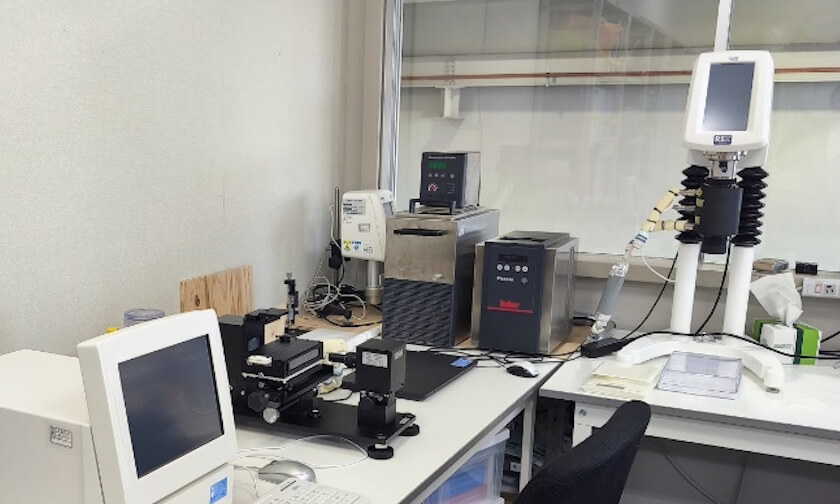
【Equipment used】 Contact Angle Meter DMs-402
Capable of measuring both liquid wettability, such as contact angle and surface tension with a single unit. With the optional temperature control unit,
changes in physical properties due to environmental variations can be evaluated.