

Surface Tensiometers
 Powered by Bioz
Surface Tension
Surface tension is a property of liquids that causes them to minimize their surface area to the smallest possible value, which would result in a perfectly spherical shape under zero gravity. Measuring surface tension allows characterizing properties such as wettability, permeability, solubility, foamability, emulsifiability, dispersibility, etc. The different methods to determine the surface tension are as follows:
Static Surface Tension Measurements
Static methods determine the surface tension of a liquid at rest after the interface has reached thermodynamic equilibrium. These techniques are ideal for characterizing pure liquids, stable solutions, and slow-acting surfactant systems.
Wilhelmy Plate Method
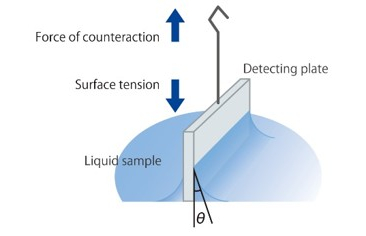
A precision balance system directly measures the pulling force exerted by the liquid interface as it wets a vertically oriented platinum plate.
Du Noüy Ring Method
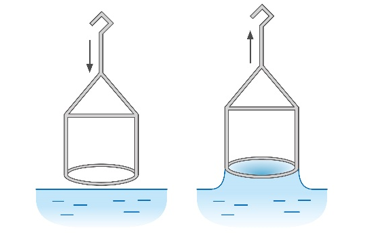
A precision balance system measures the maximum detached wetting force by gently pulling a platinum-iridium ring upward through the liquid surface.
Pendant Drop Method
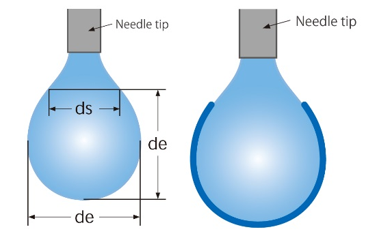
Advanced analysis software, using the Young-Laplace equation or the ds/de method, accurately determines the droplet contour from a digital image when a droplet is suspended from a needle tip.
Dynamic Surface Tension Measurements
Dynamic methods track how surface tension changes over time, specifically measuring the surface age from the moment a new interface is created. This technique is essential for evaluating rapid surfactant migration and fluid behavior in high-speed processes such as spraying, printing, and coating.
Bubble Pressure Method
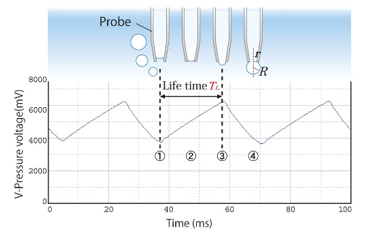
The system determines dynamic surface tension by precisely measuring the maximum internal pressure of an air bubble as it forms at the tip of a capillary probe immersed in the liquid.
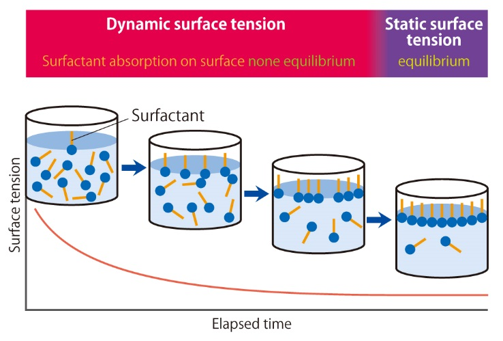
Understanding the Transition: Static vs. Dynamic
Surfactants require time to migrate and absorb at newly formed interfaces. The window between initial surface creation and ultimate thermodynamic equilibrium is where dynamic surface tension dominates. Once the interface reaches full equilibrium, it is considered to have static surface tension.
For industrial processes where surfaces are continuously generated — such as high-speed coating, printing, and detergent applications — monitoring this dynamic transition phase is critical for ensuring proper formulation performance.